About Skriptr
Who we are
Skriptr is an AI research and writing platform. We help students write better academic papers without handing their thinking over to AI: you make the choices, the AI does the heavy lifting, and every claim stays traceable to a source you chose.
We started our journey in Norway at NTNU School of Entrepreneurship. Now we’re going global.
Our story
Why we built Skriptr.
We handed in a semester paper with two sources that didn’t exist. We had used AI to help pull the literature together. We trusted what came back, so the two fabricated references went unnoticed, sitting next to a dozen real ones, until our professors found them. For a student, that isn’t an embarrassment, but the kind of thing you get thrown out for.
We admitted it that same day and said plainly that we should have checked. We took a bad grade, a pass but barely, and that was the end of it - probably only because we owned it straight away. It was our carelessness and nobody else’s.
But when we went looking for what we should have done instead, there wasn’t much to find. Not in the course, where two supervisors on the same module told us different things. Not from the universities either, as education is still working out how to handle this, and the technology has moved faster than anyone’s had time to answer it. Meanwhile, your deadline doesn’t move.
We kept wondering whether that was just us being sloppy, or something most people were walking into, so we asked: twenty long interviews with first-year students, and ninety-four survey responses. We were nowhere near alone. The biggest fear students carry isn’t a bad grade. It’s being accused of cheating, and three out of four named it. Only about one in seven actually wanted an AI that would write the thing for them.

The obvious lesson was to stop using AI. We didn’t, and the work was genuinely better for it as we got through more readings than we would have alone, and understood more of it. The problem was that none of these tools were designed for academic work. They’re built to hand you an answer. Staying in the process was never part of the workflow: the checking, deciding, owning of what you wrote.
So we started building. Nothing like a product yet, just checks and habits, a way of working that meant we could trust what we handed in. By the time we came to write our master’s thesis a year later, it had a name - SKRIPTR - and the thesis became its test project. Every gap in the tool was one we had hit ourselves that week.
It kept outgrowing what we had built it for. We had built it to keep us honest; it ended up making us better. Better at finding the reading, at arguing with it, at working out what we actually thought before we wrote any of it down. So we pushed harder until we understood how to use it properly in academic work. That’s what made the difference: not the AI on its own, but knowing how to work with it. We had figured out how to use AI well, and we wanted everyone else to be able to do the same. That’s exactly why we’re building Skriptr.
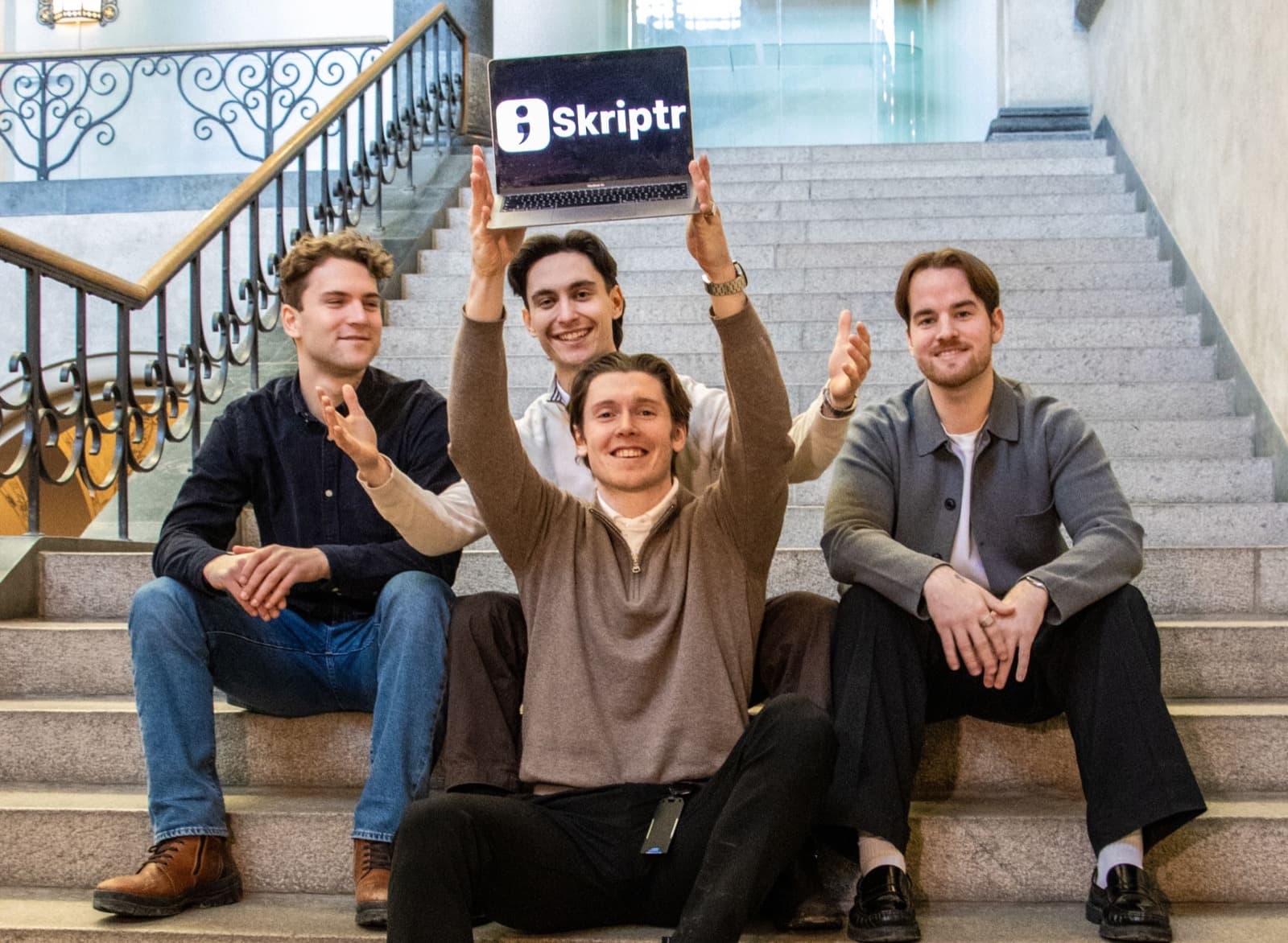
It also changed what we thought the problem was. No student should have to choose between doing their best work and being able to prove it’s their own - but that’s the choice everyone gets right now. Some students have worked out how to use these tools properly: they read more than they otherwise would and argue better for it. Others refuse the tools completely and fall a little further behind each semester. Most sit somewhere in between: using AI a bit, but never enough to get much out of it, never quite sure they should be using it at all. Not because they can’t. Because of the uncertainty. They are the ones we are building Skriptr for.
We could have just put a chatbot behind a nicer interface. Instead, we started with where the AI gets its material, because everything else depends on that. It can only work from what you give it. Nothing it says comes from anywhere else. That one decision is what makes the rest possible: everything you’re reading for a subject sits in one place, and the AI works from that, all semester. It asks what you think before it writes anything. It shows you where two of your sources disagree. It argues against your case while there’s still time to fix it. And every claim it makes points back to a page you can open.
Academia is going to look very different in a few years. The question is whether students come out of it more capable than they went in, or less - and what gets built now decides which.
That’s the bet: not that AI makes students faster but lazier, but that it can make them better, if somebody builds it that way.
Skriptr is built to raise the bar for what you can do, not to do it for you.

Vision
A world where every student can reach their full potential.
Mission
To pioneer how students and researchers use AI to elevate their learning, raise the quality of their work, and become high performers.
Contact
Talk to us
Behind us
Backed by people who bet on Skriptr
Investor

Backers

 Founders Hub